Meta Description: Discover how Uniform Appraisal Dataset (UAD) compliance can protect your appraisal license, speed up loan closings, and grow your business in 2025. Free compliance checklist inside. Slug: /uad-compliance-checklist-appraisers-2025/
If you’ve been in the appraisal business for more than five years, you remember the chaos when UAD first rolled out. Fannie Mae and Freddie Mac’s Uniform Appraisal Dataset wasn’t just a new form; it was a complete overhaul of how appraisal data is standardized, transmitted, and reviewed by automated systems.
Today, UAD compliance isn’t optional. It’s the foundation of sustainable appraisal practice. And right now, with the GSE, the margin for error is narrower than it has ever been.
Whether you’re a seasoned certified general or just starting your appraisal career, one thing is clear: what you don’t know about UAD compliance can and will cost you clients, time, and income.
Warning: Freddie Mac’s Loan Collateral Advisor and Fannie Mae’s Collateral Underwriter both flag UAD formatting errors automatically. Repeated flags can result in your license being placed on a lender’s “do not use” list without any formal notice to you.
What Exactly Is UAD and Why Does It Matter Right Now?
The Uniform Appraisal Dataset (UAD) is a standardized data format developed jointly by Fannie Mae and Freddie Mac under the guidance of the Federal Housing Finance Agency (FHFA). It defines exactly how appraisal data must be entered, coded, and reported on the URAR (Uniform Residential Appraisal Report), the 1073 (Condo), and related forms.
The goal was simple: make appraisal data machine-readable. Instead of a narrative saying, “The kitchen was recently updated,” UAD requires specific coded values like “Cn3” for condition and “Q2” for quality. Every field has a defined set of acceptable entries, and deviation triggers an error flag.
Now, with UAD 3.6 replacing form-based reporting with a fully dynamic, data-driven model, appraisers who haven’t mastered the current UAD framework will face double the pressure. during the transition. The fundamentals haven’t changed machine-readable, standardized, auditable data, but the standards are tightening.
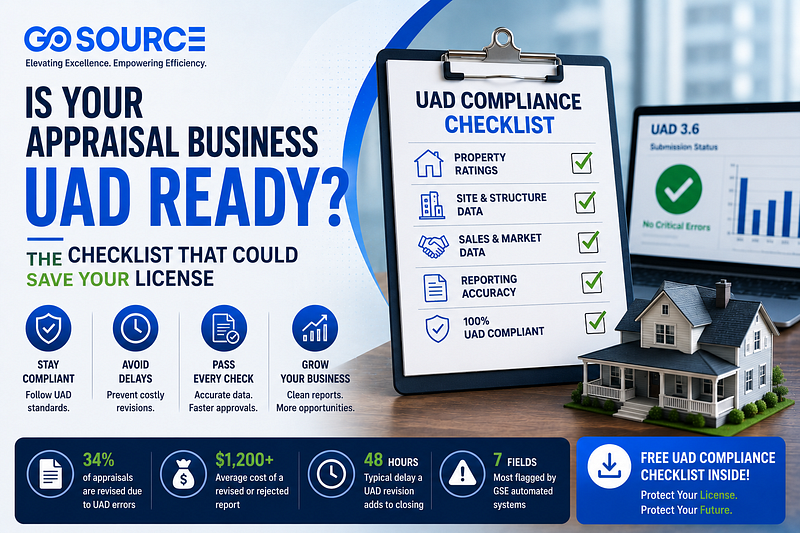
Here’s what UAD errors are costing the US appraisal industry right now:
- 34% of appraisals are revised due to UAD errors
- $1,200+ is the average cost of a rejected or revised report
- 48 hours is the typical delay a UAD revision adds to a closing
- 7 fields are most flagged by GSE automated systems
Key Insight: UAD compliance isn’t just about passing the lender review. It directly affects your collateral underwriter risk score, your value acceptance eligibility, and whether your clients’ loans close on time. Appraisers with clean UAD records get preferred placement on AMC panels.
The 7 UAD Fields That Trip Up Even Experienced Appraisers
After working with hundreds of appraisers across the US through our Appraisal Review Services and Appraisal Data Entry Services, Go Source’s team identified the most frequently flagged UAD fields:
1. Condition Rating (C1–C6) Risk: HIGH. The most common mistake is inconsistency. Your C rating must align perfectly with your interior photos, your narrative description, and your comparable adjustments. If your narrative says “well maintained,” but you rated C4, Collateral Underwriter will flag it every time.
2. Quality Rating (Q1–Q6) Risk: HIGH The Q3 vs. Q4 distinction is where most appraisers stumble, especially on tract homes. Q3 is builder-grade with some upgrades. Q4 is standard builder-grade. Misapplying these across comps creates inconsistency that automated review catches immediately.
3. Location Rating (N/B/A) Risk: HIGH UAD requires specific coded values — Neutral, Beneficial, and Adverse — for location. Entering narrative descriptions instead of coded values is a hard error in the UCDP system.
4. View Rating Risk: HIGH Combination codes must use the correct semicolon separator format. A residential water view is “restirred” — not cold.
5. Garage/Carport Risk: HIGH “2 Car Garage” is not a valid UAD entry. The correct format is “2ga.” This trips up appraisers who have been in the business since before UAD and have decades of muscle memory to override.
6. Basement Finish % Risk: MEDIUM If a basement exists, all three fields must be populated: total square footage, finished square footage, and the percentage finished. Leaving any of these blanks when a basement is present generates a flag.
7. Sale or Financing Concessions Risk: HIGH Entering “0” when concessions actually exist, even small ones, is a data integrity violation that can trigger a repurchase demand down the line. When in doubt, disclose.
Your 2025 UAD Compliance Checklist
Before you submit your next report, run through every item below. Build this into your standard pre-export workflow — not as a last-minute check, but as a non-negotiable quality gate.
Section A — Property Ratings
Condition rating (C1–C6) matches your description, interior photos, and comparable adjustments consistently, without contradiction
Quality rating (Q1–Q6) applied uniformly across the subject and all comparables — same logic, same scale throughout
View and location ratings use only GSE-approved UAD codes, with proper semicolon separators when combining codes (e.g., “Restir” not “Residential Water”)
Section B — Site & Structure Data
GLA entered in whole square feet only, no decimals, no rounding notes
Lot size in the correct unit: “sf” for under one acre, “ac” for one acre or more
Garage coded correctly using UAD format: 0ga, 1ga, 2ga, dw1, dw2, cp1, cp2. Never use free text like “2 Car Attached.”
Basement fields fully populated when a basement exists: total sq ft, finished sq ft, and percentage finished all three, every time
Section C — Sales & Market Data
All comparables have Days on Market (DOM) populated.
blank.
Sale or financing concessions reported accurately “0” only when concessions are truly zero, not just undisclosed
Date of sale formatted exactly as mm/dd/yyyy, no variations
Neighborhood market trend coded as “Increasing,” “Stable,” or “Declining,” not narrative descriptions
Section D — Consistency Checks
Condition and quality ratings are internally consistent across the subject and every comparable, with no unexplained jumps
Adjustments align logically with your ratings; a condition adjustment from C3 to C4 should be reflected in the grid
No free-text entries in fields that require UAD-coded values
Choosing UAD-Compliant Software: What to Look For
Your appraisal software is your first line of defense. Not all platforms validate UAD compliance equally. When evaluating or updating your software, look for these capabilities:
With real-time UAD validation, the software should flag non-conforming entries before you can export the report. Catching errors at data entry is infinitely cheaper than catching them after submission.
MISMO XML schema support Especially critical as UAD 3.6 shifts the entire industry to machine-readable XML output and away from static PDF forms. Your software needs to support this transition.
EAD portal integration Direct integration with Fannie Mae’s Electronic Appraisal Delivery (EAD) portal eliminates the manual upload step and reduces transmission errors.
Field-level audit trails for E&O protection; you want a log showing what was entered, what was changed, and when. This documentation is invaluable if a report is ever challenged.
Pro Tip for AMC Relationships: Appraisers who proactively share their UAD error rate, especially if it’s below 5%, with AMCs during onboarding consistently getting higher assignment volumes. Your compliance record is a competitive differentiator. Treat it like one. Go Source’s Clients Connecting Solutions helps appraisers position themselves with exactly this kind of track record when connecting with new lender and AMC relationships.
The UAD 3.6 Upgrade: What’s Coming and How to Prepare Now
The GSEs are actively rolling out 3.6, and it’s not a distant deadline. Key changes include:
Dynamic reporting structure. Report format adapts to property type and assignment complexity instead of forcing every job into a rigid, one-size-fits-all form.
Expanded standardized fields, more property characteristics, more neighborhood data points, and more required coded values. Appraisers who are already inconsistent with the current UAD fields will face compounding pressure.
Full XML/MISMO output. Static PDF reports are on their way out. UAD 3.6 produces machine-readable XML files that flow directly into lender and GSE systems without manual re-entry.
Real-time automated validation. Errors flagged at the point of data entry, not weeks later during underwriting.
Appraisers who master the current UAD framework now will absorb UAD 3.6 with a fraction of the learning curve. Those who’ve been half-compliant for years will feel the transition acutely. Read the full UAD 3.6 breakdown here.
How Go Source Helps Appraisers Stay Compliant and Competitive
Managing UAD compliance while running a full appraisal practice is a real operational challenge. Go Source’s team works alongside appraisers and AMCs across the US to take the operational burden off your plate:
We at Appraisal Data Entry Services ensure your UAD fields are entered accurately and consistently — every report, every time. Our Appraisal Review Services catch UAD errors before they reach the lender, and our Appraiser’s Office Management Solution gives you back the time to focus on inspections and analysis rather than administrative compliance.
For more resources, guides, and industry updates from the Go Source team, visit our Resources Hub.
The Bottom Line for US Appraisers
UAD compliance is no longer a back-office concern. It’s a front-line business issue that affects your income, your lender relationships, and your professional reputation.
The appraisers thriving right now share one trait: they treat compliance as a competitive advantage, not a burden. They know their error rates. They audit their own reports. They’ve built UAD validation into their workflow, not bolted it on as an afterthought.
Don’t wait for a revision request, a UCDP hard stop, or a quiet removal from an AMC panel to take UAD seriously. Start with the checklist in this post. Audit your last ten reports against it. Identify your two or three most common error patterns. Then fix them systematically, permanently.
And when you’re ready to take the operational pressure off your plate entirely, Go Source is here to help.